
By Lara Sinclair


Model how long your money could last in retirement alongside Age Pension entitlements and other income using our drawdown calculator.
Summary
Drawing an income in retirement can be scary if you’re worried about how your money might last. Here’s how to use our new drawdown calculator to model different scenarios.
How long will my super last? It’s the second question most people ask – right after ‘How much super do I need?’ And it can be a difficult one to answer, because retirement rarely comes with a set price tag. There are a lot of variables, such as:
- How long will you live?
- How will investment markets behave?
- How might your spending needs or circumstances change?
We know it can feel overwhelming and a bit scary for people to try to anticipate their needs in retirement. But many retirees are better placed than they think once they understand how their super can work in retirement alongside the Age Pension and other factors.
Our new retirement income drawdown calculator is designed to help you manage your retirement income, and anticipate different scenarios, with confidence.
How drawing an income from super works
There are several ways to access your super in retirement, from withdrawing a lump sum, to creating an income stream from your super – whether that be a transition-to-retirement strategy, an account-based pension or an annuity or lifetime pension – or some mixture of the above.
But once you’ve retired, it’s important to understand how to manage the amounts you’re withdrawing over time so you can have confidence your super will last.
You could be retired for 30 years or more. If you’ve never modelled how long your money could last, here are a few things to keep in mind.
How long will my super last?
The four main things that usually affect how long your money could last are:
- Your balance,
- How much you withdraw (and when you withdraw it),
- Your investment returns, and (for many people)
- How much Age Pension you receive.
These are precisely the things our retirement income drawdown calculator takes into consideration. It does the sums to present you with an easy-to-understand annual income amount and projection for how long your money could last, based on the information you feed in.
The calculator makes some key assumptions about inflation and investment returns, such as investing your super at a return of 6.7%. But you can change these if you want to invest your money more conservatively, or if you are prepared to take on a little more risk in exchange for potentially higher returns.
The things many retirees miss
What else should you know when you’re planning how to manage your money in retirement? If you’re concerned about spending more than the bare minimum, consider the following:
1. Retirement savings are designed to be spent
Switching from saving for retirement to spending in retirement can feel uncomfortable, even though your balance might be doing exactly what it was designed to do.
In other words, super is not meant to be a nest egg to be protected indefinitely. It is intended to help fund your life after work.
The lesson here is not that everyone should spend more; but that it’s important to understand what your savings may reasonably support instead of allowing fear alone to set your budget.
2. Your money doesn’t stop working when you do
Retiring doesn’t necessarily mean withdrawing all your super and placing it in a bank account.
If you meet a condition of release and start an account-based pension with your super, all your withdrawals are generally tax-free.
And so are the investment returns your money generates. There is a maximum amount that can be used to start a tax-free retirement phase income stream called the Transfer Balance Cap, which is $2.1 million in 2026-27.
In comparison, investment earnings in the accumulation phase are generally taxed at up to 15%.
The ‘snowball’ effect of super invested in a tax-free environment may mean your super earns more after you retire than it did when you were working.
Plus, transferring your balance to a tax-free retirement income stream, such as that provided by an account-based pension, may also result in a retirement ‘bonus’ for eligible members, based on your super balance.
Learn how to set up an account-based pension or learn more about the CFS pension bonus.
3. Retirement spending often changes with age
Retirement spending is unlikely to be the same every year, so it’s important to account for contingencies and stand-alone events that may see your spending peak at times.
Despite that, there are some general patterns to note.
Typically, your first years after retirement may be your most active.
You may travel more, renovate, pursue hobbies or spend more time with family while you have the health and energy to enjoy these experiences.
As people move through their 70s, spending on travel, transport and leisure may taper. Healthcare costs may rise, but overall spending tends to fall or remain relatively stable as people age.
We’re here to help you retire with confidence
At no extra cost for CFS members, our guidance consultants can help you:
- Easily set up an account-based pension with our simple digital process.
- Better understand account-based pensions and retirement income streams, including how they can benefit you.
- Answer any questions you may have about retirement planning or super boosting strategies.
- Recommend more comprehensive financial advice, if that’s what you need.
4. The Age Pension and your super are designed to work together
People sometimes believe that receiving the Age Pension in retirement means they have not saved enough. Others assume that having any super automatically makes them ineligible to receive the Age Pension.
Neither is necessarily true.
Australia’s retirement income system brings together super, the means-tested Centrelink Age Pension or DVA Service Pension, and private savings.
Many Australians use a mixture of super and Age Pension payments, and that mixture can change over time. For example, you may initially fund more of your lifestyle from super and become eligible for a part-Age Pension later as your assessable assets decline.
That’s why it’s worth regularly checking your Age Pension eligibility to see if you qualify as your balance changes.
5. The minimum drawdown amount may not be your ideal income
Account-based pensions have minimum annual withdrawal requirements. For people aged under 65, the minimum drawdown rate is currently 4% of the account balance. It rises to 5% from ages 65 to 74 and increases progressively as you age.
This is a regulatory requirement, not a recommendation about how much you should spend.
Depending on your balance, planned lifestyle, Age Pension entitlement, investments and other resources, you may be able to draw more.
Alternatively, if you want to preserve a buffer, or if you have substantial income outside super, the minimum may be enough.
Experimenting with different withdrawal strategies can help you understand the longer-term effect on your balance before you change your pension payments.
If you need more help, CFS can also connect you with a range of advice options, from free general advice to one-off consultations on retirement planning, or more complex, comprehensive financial advice. Explore your advice options
Understanding how much super you may need
Before experimenting with the drawdown calculator, think about how much super you may need based on what you expect to spend in retirement.
You may consider things like:
- Your current household budget
- Whether your mortgage, commuting and takeaway lunch expenses might decrease
- Will your travel, hobbies, home maintenance or health insurance costs increase?
One way of estimating your spending can be to separate your spending into three categories:
- Essentials, such as food, utilities, insurance, transport and healthcare
- Lifestyle spending, such as travel, dining out, hobbies and entertainment
- Occasional costs, such as replacing a car, renovating your home or helping family
This may provide a more realistic annual income target than, for example, assuming you will need a fixed percentage of your salary.
Test your plan with the retirement income drawdown calculator
Once you have an idea of how much super you might need, you can start modelling how long it might last.
To help you model different scenarios, the CFS retirement income drawdown calculator will ask you to enter relevant information.
The information you’ll need to model different outcomes
When you use the calculator, you’ll be asked to enter things like:
- Your age
- Your pension or super balance
- If you have a partner – and if you do, their age and super balance.
Then you’ll be able to include:
- If you have any assets outside super
- If you own your own home, and
- Whether you earn any form of income from casual or part-time work in retirement.
Finally, it will ask how you would like to calculate your retirement income, either:
- Based on making your money last until a particular age (say, age 92), or
- By setting a yearly target income and seeing how long it lasts.
The projection will change depending on what you enter – such as whether you work part-time, the age at which you retire, whether you are part of a couple, or if you include income from another source, such as an inheritance or investment.
What the calculator will give you
The calculator will generate a chart that shows you what your annual income might be given the information provided. Note that it provides an estimate based on the numbers you enter and the assumptions that are part of the calculator. It is not designed to be a definitive projection.
The chart will include:
- Your current balance
- Your estimated yearly income in retirement
- The proportion of your annual income each year that might be provided by your super
- The proportion of your annual income each year that might be provided by the Age Pension (if applicable).
It can also show you how your balance might be expected to decrease over time. You can adjust the outcomes by altering:
- Your retirement age
- Whether you work part-time or not
- How your money is invested, and
- How your spending might change if you were to include a holiday, for example.
It’s worth experimenting with the figures you enter and seeing how different decisions might affect your predicted outcomes, prior to making your own retirement income drawdown plan.
The following examples are illustrative only and are designed to highlight what you might explore in the calculator.
Case study 1: Hannah is about to retire. She has $420,000 in super
Hannah is 66, single and about to retire. Her home is paid off, and she has $420,000 in super.
She starts by using the Association of Super Funds of Australia-recommended benchmark for a comfortable lifestyle ($55,923 per year or $1,071 per week) and enters her super balance to see when it would be likely to run out (using the standard assumptions within the calculator).
Hannah can see from the below projection that an Age Pension payment, included from age 67, could supplement the income from her super for most of her retirement.
Hannah’s initial retirement forecast:
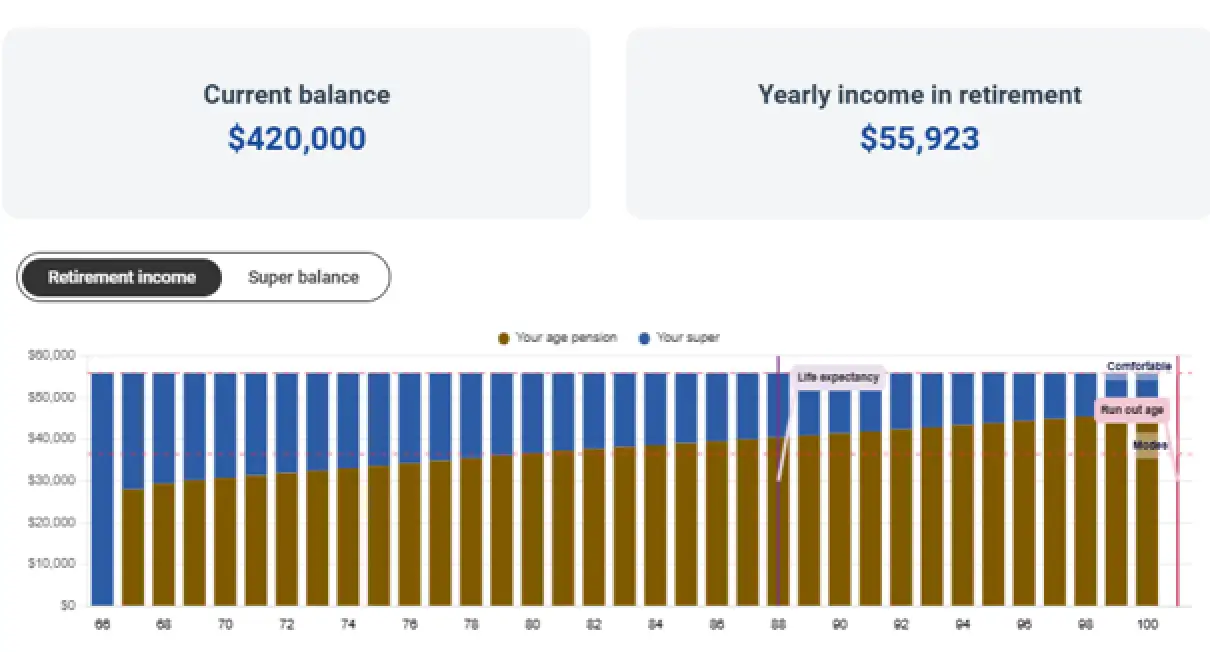
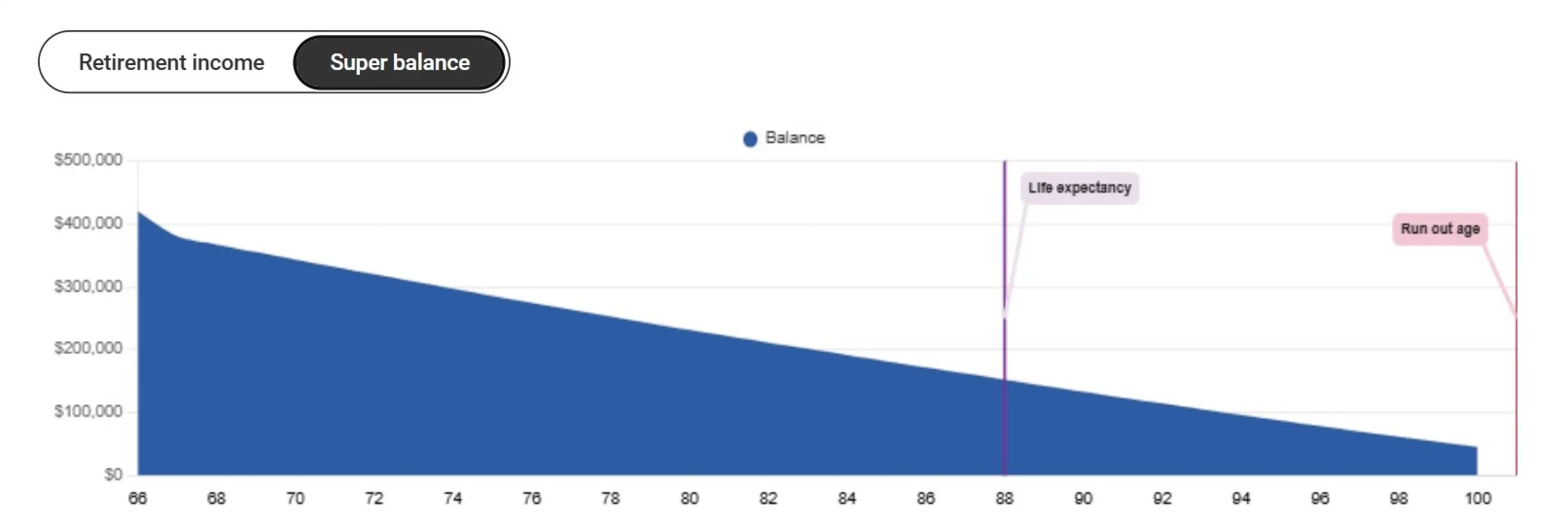
Hannah can see from the initial projection that she is likely to be entitled to some Age Pension from age 67 and can factor that into her retirement plans.
Case study 2: A couple with different retirement dates
Michael, 67, has retired, while David, 63, plans to work part-time for another three years. They have combined super of $650,000, a small investment portfolio and no mortgage.
They include both partners in the calculator and test what happens when David’s employment income stops. They also explore how their potential Age Pension eligibility may change as David reaches Age Pension age and their assessable assets change.
This gives them a household view rather than treating each super balance in isolation.
Case study 3: A recent retiree worried about market volatility
Aisha is 69 and retired two years ago. After a period of market volatility, she is concerned that her $510,000 pension balance will not last.
She reruns her projection using her current balance and updated spending. She tests a modest reduction in discretionary spending and compares different investment-return assumptions.
While this exercise does not remove market risk, it helps Aisha understand whether a short-term market move materially changed her long-term position before she makes a major decision.
What could change your outcomes
How your money could last in retirement may change over time, so it’s worth asking the question, and testing different outcomes, more than once.
Your projections may change as investment markets move, your spending evolves, your home and family circumstances change, and your Age Pension eligibility increases or decreases.
Try it now, and feel free to run it again whenever something significant changes.
You may discover that you need to adjust your spending plans. But you may also find that you can afford to spend a little more in the years when you are most active and able to enjoy it.
Either way, having a clearer picture can provide you with the reassurance you need to approach retirement with more confidence.
Options for income that lasts for life
A final thought when it comes to how well your money might last in retirement: lifetime pensions or annuities that provide a guaranteed income for life may provide another level of reassurance if you’re worried about running out of money later in retirement.
In fact, some modern lifetime pension products are assessed more favourably by Centrelink under current means-testing rules and may result in higher Age Pension payments.
Learn more about how this works
Ready to explore your retirement income?
Use the CFS Retirement Income Drawdown Calculator to estimate how your super, investments, other income and potential Age Pension entitlement could work together throughout retirement.
Frequently asked questions
There’s no upper limit on the amount you can withdraw from your super once you meet a condition of release, such as retiring from age 60 or turning 65, although there are minimum drawdown rates if you move your super into a tax-free retirement income stream, such as an account-based pension.
Yes. If you have reached your preservation age (generally 60), you can draw an income from your super via a transition to retirement pension and continue working. You can also retire from a job, or change jobs, and continue working at the same or reduced hours.
Generally, the balance of your super account is assessed under Centrelink’s assets test and deemed to return a certain amount of income if you start an account-based pension or if you have reached age 67. Together with any other assets or income you have, that will affect how much Age Pension you will receive. Centrelink applies both an assets test and an income test – whichever test results in the lower Age Pension payment is the one that will apply.
If your super runs out, and you meet the eligibility requirements, such as being 67 or over and an Australian citizen, you may be able to access the government Age Pension and other social security benefits.

Want peace of mind about your financial future?
‘It's really a privilege to have the opportunity to effectively join people in their homes and impart the knowledge that we have for the best interest of our customers’, says Executive Director of Advice – Neville Azzopardi.
Advice options for every stage of life.
Together in one place.
What's next?

Your complete guide to the government Age Pension
More than half of all retirees are likely to access a part- or full Age Pension at some point during their retirement. Could you be eligible?

CFS and Care & Co Match are here for you when life changes
Access help from a care concierge team to navigate aged care, home care, and life’s big changes with confidence – and at a discounted rate.

Ask an adviser: How much does advice cost?
As part of our Ask an adviser series, CFS Executive Director of Advice Neville Azzopardi answers the question: How much does financial advice cost?
Disclaimer
Avanteos Investments Limited ABN 20 096 259 979, AFSL 245531 (AIL) is the trustee of the Colonial First State FirstChoice Superannuation Trust ABN 26 458 298 557 and issuer of FirstChoice range of super and pension products. Colonial First State Investments Limited ABN 98 002 348 352, AFSL 232468 (CFSIL) is the responsible entity and issuer of products made available under FirstChoice Investments and FirstChoice Wholesale Investments.
Information on this webpage is provided by AIL and CFSIL. It may include general advice but does not consider your individual objectives, financial situation, needs or tax circumstances. You can find the target market determinations (TMD) for our financial products at https://www.cfs.com.au/tmd which include a description of who a financial product might suit. You should read the relevant Product Disclosure Statement (PDS) and Financial Services Guide (FSG) carefully, assess whether the information is appropriate for you, and consider talking to a financial adviser before making an investment decision. You can get the PDS and FSG at www.cfs.com.au or by calling us on 13 13 36.