
Summary
In this edition of Market Insights, CFS Chief Investment Officer Jonathan Armitage reviews July's market performance, where strong company earnings in the United States and Europe supported markets, while rising bond yields, geopolitical uncertainty and growing scrutiny of artificial intelligence investment created a more complex backdrop.
Global markets continued to move higher
Global markets generally moved higher through July, supported by resilient economic activity and another solid earnings season in the United States and Europe.
Global markets rose by around 0.8% during the month, while the S&P 500 ended July at around 7,490, up around 0.3%. European markets also delivered positive returns, gaining around 3.0% over the month.
A large part of that strength reflects solid company earnings and continued investment in artificial intelligence-related infrastructure and technology. Technology company earnings in Q2 have remained strong and companies in the US have shrugged off weak consumer sentiment and higher energy prices.
However, while company earnings have generally remained strong, investors have become increasingly cautious about rising bond yields, geopolitical uncertainty and the growing cost of AI investment.
A growing divergence between markets
One of the more notable features of July was the steady increase in bond yields.
While the moves were gradual, they became more noticeable as the month progressed. Bond markets have continued to reflect concerns about inflation, government borrowing and the possibility that interest rates may remain higher for longer.
This matters because higher bond yields can influence borrowing costs and affect how investors think about different investment opportunities.
As a result, investors are balancing encouraging earnings results against a bond market that remains more cautious about the broader outlook.
Like many periods in financial markets, different markets appear to be sending slightly different signals. This makes the overall picture harder to interpret and means investors need to look beyond any single indicator.
Artificial intelligence remains a key theme
Artificial intelligence remained one of the dominant themes during July.
Technology companies continue to invest heavily in data centres, computing infrastructure and AI development. While investors remain optimistic about the long-term potential of AI, they are paying closer attention to the scale of that spending and how it is being funded.
This growing caution has become visible not only in share prices, but also in credit markets.
Figure 1: Credit default swap spreads for selected technology companies (January to July 2026)
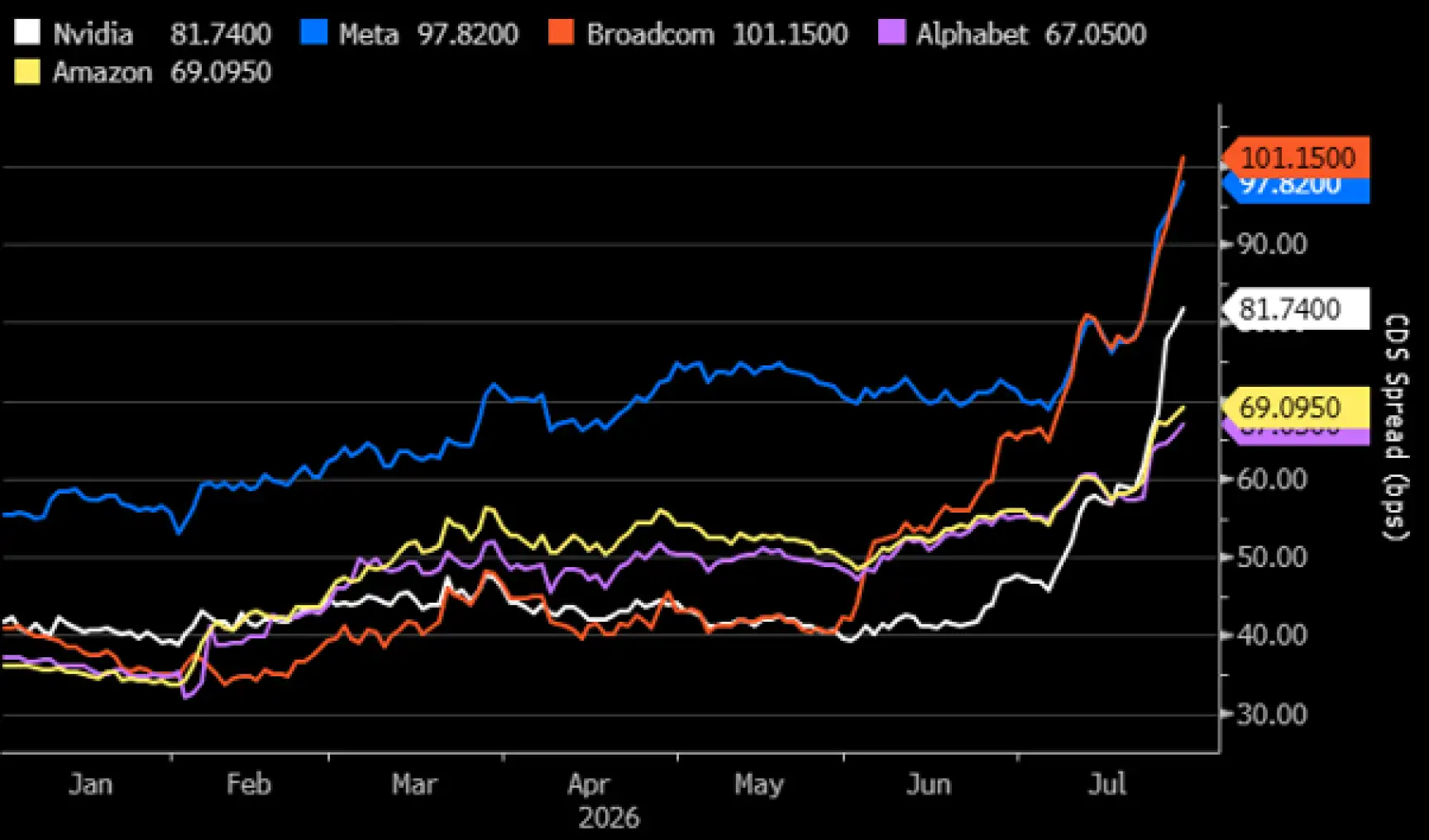
Credit default swap spreads moved higher across several major technology companies during the first seven months of 2026, reflecting growing investor focus on AI-related investment.
Credit markets also reflected growing investor caution around AI-related investment.
Credit default swap spreads moved higher across a number of large technology companies during 2026. Broadcom's spread rose from around 40 basis points in January to around 101 basis points by the end of July, while several other technology companies also recorded increases over the period.
Credit default swaps measure the cost of insuring company debt. While these levels remain well below those typically associated with financial stress, the increase suggests investors are paying closer attention to the amount being invested in AI and when those investments may begin to generate returns.
Investors are increasingly asking when AI-related investment will begin delivering meaningful returns.
Geopolitical tensions continue to influence markets
Geopolitical developments also remained an important part of the backdrop throughout July.
While conditions appeared calmer than during periods of heightened conflict earlier in the year, underlying tensions in the Middle East remain unresolved and continue to contribute to investor uncertainty.
What matters in the current environment is not simply that geopolitical risk exists, but how it interacts with pressures that are already present.
Energy markets are often the most visible starting point, but the broader effects can emerge through less visible channels. Higher energy costs, transport costs and supply-chain disruption can influence inflation and economic activity over time.
Australia was more subdued
The experience was more uneven at a regional level.
Australian shares rose during July, but gains were more modest than in many overseas markets. The S&P/ASX 200 increased by around 1.1% over the month, compared with stronger gains globally.
Consumer confidence remained relatively subdued, yet spending continued to prove more resilient than many economists had expected.
At the same time, the Reserve Bank of Australia has maintained a cautious tone as inflation pressures remain above its preferred range. Policymakers continue to monitor inflation, labour market conditions and household spending closely.
Together, these factors point to a domestic backdrop that remains mixed. While some households continue to spend confidently, others remain under pressure from higher living costs and borrowing costs.
Emerging markets highlight the gap between fundamentals and sentiment
Some emerging markets experienced greater volatility during July, particularly in parts of Asia where technology companies have benefited from strong demand for AI-related investment.
The MSCI Emerging Markets Index returned around -1.0% during the month, although performance varied across regions.
South Korea was a particularly notable example.
Several large semiconductor companies, including SK Hynix and Samsung Electronics, experienced significant share-price swings as investors reassessed expectations for AI-related growth following exceptionally strong gains earlier in the year.
SK Hynix, one of the world's leading memory-chip manufacturers, continued to benefit from strong demand for AI-related technologies and reported revenue growth of approximately 540% year-on-year. Despite those strong results, share-price volatility increased as investors questioned the sustainability of very strong earnings.
At times, Korean technology stocks experienced daily moves of between 8% and 10%, demonstrating how quickly sentiment can change when future expectations become elevated.
This serves as a reminder that strong business performance does not always translate into smooth market returns.
What this means for investors
For superannuation members and customers holding investments, the key point is that positive market returns do not mean risks have disappeared.
What we have seen through July is an environment where company earnings have remained supportive, particularly in the United States and Europe, but where the drivers of market performance are becoming more mixed.
Some markets continue to benefit from strong earnings and investment in artificial intelligence, while others reflect caution around bond yields, geopolitical tensions and the growing cost of AI-related investment.
Portfolio positioning at CFS
At CFS, portfolio construction reflects this uncertainty.
Diversification across regions, investment styles and asset classes remains central, alongside ongoing monitoring of inflation, interest rates and geopolitical developments.
We continue to diversify our investments to manage risk and position portfolios to navigate a range of market conditions.
This approach is designed to balance capturing long-term growth opportunities with managing shorter-term risks and volatility.
The role of diversification
Different parts of markets respond differently to the same set of conditions, and a diversified portfolio is better placed to manage those differences over time.
Periods like this highlight the importance of diversification, valuation discipline and long-term thinking in navigating uncertain market environments.
Looking ahead
While returns through July have generally remained positive, the broader environment is becoming more complex.
Bond yields, inflation, geopolitical developments and the sustainability of AI-related investment are all likely to remain important influences in the months ahead.
Company earnings have remained supportive, particularly in the United States and Europe, but investors continue to balance those positive results against uncertainty around interest rates, government borrowing and global growth.
In this environment, maintaining a disciplined and diversified investment approach remains critical.
Related articles

Disclaimer
Avanteos Investments Limited ABN 20 096 259 979, AFSL 245531 (AIL) is the trustee of the Colonial First State FirstChoice Superannuation Trust ABN 26 458 298 557 and issuer of FirstChoice range of super and pension products. Colonial First State Investments Limited ABN 98 002 348 352, AFSL 232468 (CFSIL) is the responsible entity and issuer of products made available under FirstChoice Investments and FirstChoice Wholesale Investments. This webpage may include general advice but does not consider your individual objectives, financial situation, needs or tax circumstances. You can find the Target Market Determinations (TMD) for our financial products at www.cfs.com.au/tmd, which include a description of who a financial product might suit. You should read the relevant Product Disclosure Statement (PDS) and Financial Services Guide (FSG) carefully, assess whether the information is appropriate for you, and consider talking to a financial adviser before making an investment decision. You can get the PDS and FSG at www.cfs.com.au or by calling us on 13 13 36.